 UTTA LMS
30 Courses
Principles of Plant Pathology
This course, designed for undergraduate students, offers a theoretical understanding of principles underlying nature, pathogenesis, disease assessment, disease diagnosis, and plant disease management. The laboratory complements lecture topics by providing hand-on experience with plant disease diagnosis and various plant disease management approaches. By the end of the course, students will have a comprehensive understanding of disease development and disease management. Through writing and research assignments, students will also improve their analytical and critical thinking skills as well as their writing skills.
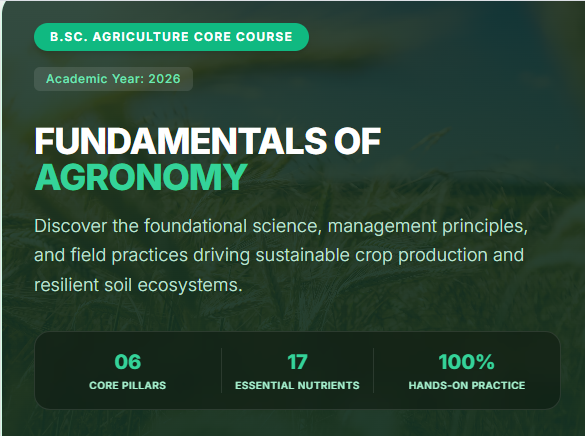
Fundamentals of Agronomy
The Fundamentals of Agronomy course introduces the science of crop production and soil management.
Mathematics in Real Life
- Mathematics in Real Life is a practical course that connects mathematical concepts with everyday activities. It helps students understand the use of mathematics in shopping, budgeting, banking, business, and personal finance. The course covers topics such as percentages, ratios, algebra, geometry, statistics, and probability. Students learn how to analyze data, solve practical problems, and make logical decisions. It also demonstrates the importance of mathematics in science, technology, education, and professional life. Overall, the course develops problem-solving, analytical, and critical-thinking skills. It helps students recognize mathematics as an essential tool for managing and understanding real-life situations.

Principle of finance
Basic course of the business department. This course helps to give a basic understanding of finance.
Genetic Engineering and Biotechnology
Genetic Engineering and Biotechnology (GEB) is an applied science subject. The technology used in genetic engineering is generally aimed at harnessing the natural biological capabilities of microbial, plant, and animal cells for the benefit of humans. This technology, more specifically termed "Biotechnology", couples scientific and engineering principles with commercial considerations to develop and improve products and processes made from living systems.
Stress Physiology
Stress Physiology is the study of how plants respond and adapt to various environmental stresses that affect their growth, development, and productivity. The course covers both abiotic stresses (such as drought, salinity, flooding, temperature extremes, and heavy metals) and biotic stresses (caused by pests and pathogens). It explains the physiological, biochemical, and molecular mechanisms involved in stress perception, signal transduction, osmotic adjustment, antioxidant defense, and stress tolerance. The course also highlights the role of plant hormones, stress-responsive genes, and modern management strategies, including breeding and biostimulant applications, to improve plant resilience and sustain crop production under changing environmental conditions.
Disaster Management and Vulnerability
Disaster Management and Vulnerability is a course that introduces students to the concepts, causes, dimensions, and social impacts of disasters and vulnerability. It examines how natural and human-induced hazards affect individuals, communities, and societies, with particular attention to vulnerable and marginalized populations. The course also explores disaster risk reduction, preparedness, response, recovery, resilience, and the role of communities, institutions, and government in effective disaster management. Through a sociological perspective, students develop an understanding of vulnerability, adaptation, resilience, and sustainable disaster risk management.
Introduction to Pharmacy
Introduction
to Pharmacy is a two-credit course offered in the first semester of the B.
Pharm program. The
goal of this course is to provide the students an overview of the history and
evolution of Pharmacy as an independent profession in different settings such
as industry, hospital, community, and clinical, and role of the pharmacist in
health care. The
course also includes the fundamentals of different dosage forms and role of
pharmacist in dispensing and management of medicines.
Fundamental of Organic Chemistry
Fundamental organic chemistry Course for Chemistry Undergrad Students
Remote Sensing and Photogrammetry
Zoom Class:
https://us04web.zoom.us/meeting/76514272035?meetingMasterEventId=Fg3zreYLQ92BmVQyXPFlFg

 UTTA LMS